File this under the department of “the more things change, the more they stay the same”.
Musicians often hold multiple roles simultaneously inside and outside of music throughout their careers. It was no different in the 1960s. Here, in this article in the Kitchener-Waterloo Record in 1968, composition professor Talivaldis Kenins discussed the difficulties that face composers.
Faculty of Music composition professor Talivaldis Kenins taught at the Faculty of Music from 1952 to 1984. The stamp was issued by the Latvian government in 2012 in honour of him for the 100th anniversary of Latvia in 2018.
Kenins Kitchener-Waterloo Record article 8 March 1968
We can thank Greta Kraus for the strength of the classical music community in Toronto today.
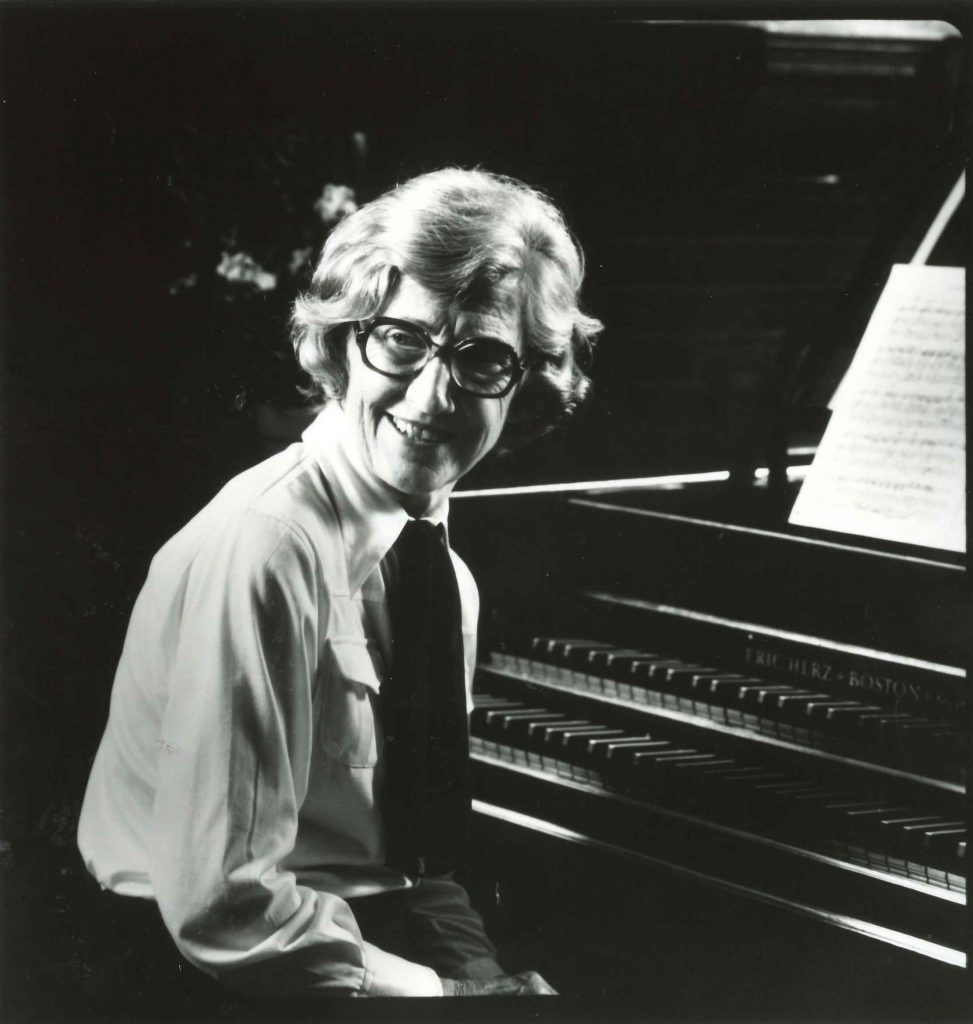
Arriving to Toronto in 1939, Greta Kraus went on to form the Toronto Baroque Ensemble and the Aitken-Kraus Duo with flutist Robert Aitken. She taught at the Royal Conservatory of Music from 1943-69 and at the Faculty of Music from 1963 until near her death in March 1998. Known as an outstanding and influential performer, teacher and accompanist, she also coached singers ranging from Teresa Stratas to Russell Braun.
“At 3:00 p.m. on 8 May 1998, a congregation of approximately three hundred individuals assembled in Walter Hall at the Faculty of Music, University of Toronto, to pay tribute to one of Canada’s preeminent musicians and teachers, the harpsichordist and pianist Greta Kraus (b. Vienna, 3 August 1907; d. Toronto, 30 March 1998). It was a wonderful event, both sad but at the same time exhilarating as a celebration of her rich life. There were tapes of Greta playing and speaking, tributes by former students and colleagues, and live performances by some of those whom she had coached. The outpouring of love and respect for this special person was enormous, one of those extraordinary events those of us fortunate enough to attend will remember for a long time.”
In 1994 composition professor Chan Ka Nin won his first JUNO Award for Best Classical Composition for “Among Friends”, performed by the Amici Chamber Ensemble. He went on to win another Best Classical Composition JUNO in 2002 for “Par-çi, Par-la”. Professor Chan joined the Faculty of Music in 1982 and retired at the end of the 14-15 academic year.
Almost 10 years ago the Faculty of Music Opera Division performed Cimarosa’s Il Matrimonio Segreto. Principal coach and conductor Miah Im joined the Faculty in summer 2008 and this was her first U of T Opera production.
Production photo features Catherine (Marchant) Spanu as Carolina and Erica Iris Huang as Fidalma.
Miah Im conducting Il Matrimonio Segreto November 2008
Although Music at the University of Toronto has a history dating back to well before its chartering in 1827, the Faculty of Music was established as an academic unit 100 years ago today. On June 25, 1918, six men, five of whom were organists, met at 11 am in a at University College classroom to try to achieve consensus on a curriculum for a new music faculty that had no students and offered no classes. Read more about the first Faculty Council meeting.
Flash forward 100 years and we are still trying to achieve consensus on curriculum, but we now have 950 students, hundreds of faculty, and dozens of renowned and innovative programs. We are international leaders in many areas of music creation, performance, education, and interdisciplinary research.
Together, we affirm the transculturally transformative power of music in human experience and the capacity of the arts to build healthier societies. As an important part of one of the world’s great universities in one of the world’s most diverse and dynamic cities, we are dedicated to preparing future generations of community-centred globally-informed cultural leaders.
Join us for our 2018-2019 100th anniversary season. We invite you to share your stories with us, as we use this occasion to tell more of them: then, now, and looking ahead to an exciting future.
Don McLean, Dean and Professor, Faculty of Music, University of Toronto
“I’m not just coming in as Mr. Nice. I’m prepared for the battles.” – Professor John Beckwith, as quoted in the Globe and Mail, 1 March 1970.
A new a decade brought a new Dean and the relationship between the University of Toronto, the Faculty of Music, and the Royal Conservatory of Music was uneasy. Officially the organizations split in 1991, when the Royal Conservatory of Music Act of the Ontario Legislature confirmed the separation of the Conservatory from the University of Toronto and re-established The Royal Conservatory’s status as a fully independent, not-for-profit entity.
One of the most prominent figures in the field of percussion performance, U of T Professor Emeritus Russell Hartenberger has been awarded the 2017 Leonardo da Vinci World Award of Arts.
“This recognition is for his lifetime commitment to cultivating and shaping our understanding of music and performance across cultures and genres, respecting the diversity of world traditions,” said the World Cultural Council in a news release.
The award also recognizes the former dean of the Faculty of Music’s “commitment to teaching and inspiring new generations of young musicians and scholars” and for being “a virtuoso soloist whose technical mastery encompasses virtually every percussion instrument imaginable.”
“I’m deeply honoured to receive the Leonard Da Vinci World Award of Arts from the World Cultural Council. While it is personally humbling to receive this acknowledgment, I feel that the award is a recognition by the WCC of the significance of percussion in the musical world today,” Hartenberger said.
“I also want to thank the Faculty of Music and the University of Toronto for providing the support that has allowed me to pursue a multifaceted career in music. The performers, educators, composers, researchers and students have been inspirational to me as I have pursued my various dreams.”
In 1966, Hartenberger received his bachelor’s degree from the Curtis Institute of Music, where he studied with Fred D. Hinger. He completed his master’s degree in 1969 from The Catholic University of America. In 1974, he received his PhD in world music from Wesleyan University, venturing into a range of instruments, including mridangam with Ramnad Raghavan of South India, tabla with Sharda Sahai of North India, Javanese gamelan with Prawotosaputro and West African drumming with Abraham Adzinyah.
He’s a founding member of groundbreaking percussion ensemble Nexus and was recently on tour with the Toronto Symphony Orchestra in Europe and Israel. Hartenberger has been a member of the Steve Reich and Musicians ensemble since 1971 and has performed throughout the world, including appearances with the New York Philharmonic, Boston Symphony Orchestra, London Symphony Orchestra, Israel Philharmonic, Cologne Radio Orchestra and BBC Symphony Orchestra.
Hartenberger is also the author of Performance Practice in the Music of Steve Reich (Cambridge, 2016) and editor of The Cambridge Companion to Percussion (2016).
“This award is well-deserved recognition for an outstanding career that has seen Professor Emeritus Russell Hartenberger not only push the boundaries of his field in music but also help develop other young musicians here at the University of Toronto,” said Vivek Goel, vice-president of research and innovation. “We’d like to congratulate Professor Hartenberger and thank the World Cultural Council for this incredible honour.”
Since 1984, the WCC has granted prizes to outstanding scientists, educators and artists whose breakthroughs in the fields of knowledge, learning and research have contributed positively to the cultural enrichment of mankind.
Each of the World Cultural Council’s three international awards have now been won by U of T scholars and artists.
In 2011, the Albert Einstein World Award of Science went to Geoffrey Ozin, University Professor of chemistry in the Faculty of Arts & Science and Canada Research Chair in nanochemistry.
In 2006 the José Vasconcelos World Award of Education went to Professor Marlene Scardamalia at U of T’s Ontario Institute for Studies in Education.
This year, the awards ceremony will take place on Nov. 8 at Leiden University in the Netherlands.
Featured photo (top): The World Cultural Council is awarding U of T Professor Emeritus Russell Hartenberger with the 2017 Leonardo da Vinci World Award of Arts (photo by Lauren Vogel Weiss)
You may have already heard the sweet, melancholic tunes coming out of Michael Bridge’s accordion.
He is U of T’s Accordion Guy.
Bridge started playing when he was just 5 years old and has stayed with the instrument since then. He came to U of T’s Faculty of Music for his undergrad, stayed on for grad school and on June 12th, he’ll be graduating with a master’s degree in music performance. Up next, he’ll begin doctoral work for accordion performance – also at U of T.
The accordion virtuoso says U of T’s graduate program “changed his understanding of what the accordion can do.”
Adam has been practising the same drum sequence for 20 minutes. Every time he misses a beat, he takes a breath, brushes it off and begins again. It’s the kind of focus and discipline that, until this point, he just hasn’t had in his life.
The 18-year-old has just been released from an open custody residence run by Turning Point Youth Services – a housing facility for young men who have been involved with the youth criminal justice system.
Adam (not his real name) has been coming to the Regent Park School of Music once a week to learn how to play the drums. The lessons are part of a collaboration between the music school, members of the University of Toronto’s Faculty of Music and Turning Point, which brings youth from the residences to Regent Park to learn how to play an instrument of their choice.
This program is funded by the Ministry of Children and Youth Services, the R. Howard Webster Foundation and an anonymous donor.
“Every time I come here I learn something new,” says Adam, who has just completed his first lesson since being released from open custody. “At first I used to play the drumsticks differently. They taught me the right techniques. It was hard at first, but then I got used to it.”
His passion and determination caught the eye of his music instructors, like Heather Saumer, who recognized his talent straight away.
“Right from the beginning, he had a vision for what he wanted to learn. That’s given him a real focus and direction,” says Saumer. “Those mini-accomplishments every step of the way can really build a lot of confidence and sense you’re part of a larger whole.”
The music lessons are being observed by Bina John and Nasim Niknafs, assistant professors of music education at U of T, who are researching its impact on the youth.
“The project is looking at the effect of music education, not just on establishing musical identity but also on the psycho-social benefits of making music together,” says John.
These benefits have been scientifically proven, she says. “When you make music together in an instrumental or choral ensemble, it happens right from the brain where certain chemicals are released, leading to a greater understanding of your own identity and your own needs and the needs of others,” says John.
Studying the effect of music on kids in detention is a unique opportunity, she says. “Nothing like this has ever been done in Toronto or even Canada that we know of.”
Turning Point staff member Milenka Carrasco sees the impact on the young men as she watches them air drumming or jamming on a ukulele on the way back to their residence.
“Music is definitely universal to all these young men,” she says. “They all have different stories but they’re able to connect with music on so many different levels.”
Programs like this one are at the core of what Regent Park School of Music (RPSM) does, says the school’s executive director Richard Marsella.
“It’s important for us to always look towards giving the kids who need us most that way into music,” says Marsella, who’s also a music education PhD candidate at U of T.
“My hope for this program is that it’s changing their path. It’s helping them find a voice that is meaningful and it’s reconnecting them to a community that they could not have imagined prior to coming together with our faculty and our team.”
RPSM instructors have also been going to a Turning Point facility to teach students as part of the Toronto District School Board Section 23 program, which helps students outside of the traditional school system gain access to education.
“I feel like it’s just the beginning, and we’re hoping to grow to reach even more youth in the community and also bring music into youth detention centres” says Marsella.
John also sees opportunities beyond RPSM. “Our hope is to become a model for how to introduce music education into other communities other than schools,” she says.
It’s a chance to reach and have an impact on people and communities across the city, in big and small ways.
“This just reminds them they’re not forgotten,” says Carrasco. “It reminds them whatever Toronto has to offer, it’s for them as well.”
If Adam is anything to go by, music is already making a difference.
“It brings people together 100 per cent. It mends a lot of relationships,” he says. “I could see myself doing it for the rest of my life.”
U of T’s On Location is a new series that explores how the university is involved in shaping the urban fabric and landscape of Toronto and the GTA.
Featured image (top): Richard Marsella, executive director of the Regent Park School of Music and current U of T PhD student, hopes to inspire more youth in detention with music (photo by Romi Levine)
Two acclaimed voices in Canadian opera who met as student and teacher are receiving honorary degrees from the University of Toronto on Wednesday.
Before singing at venues like the Royal Opera House in London or conducting leading orchestras, Barbara Hannigan studied music under Mary Morrison, an accomplished soprano in her own right who has taught at U of T since 1979.
Despite Hannigan’s packed schedule – she has engagements in 10 cities before the new year – she keeps in touch with her university mentor.
“I usually know what she’s up to,” Morrison says, “and she knows that I’m here.”
Although their singing careers are separated by decades, Hannigan and Morrison’s biographies offer striking parallels.
Both studied music from an early age and left their hometowns before their 18th birthday to pursue singing in Toronto and earn recognition as new-music sopranos.
Morrison, who turns 92 next week, grew up in a Scottish family in Winnipeg. She started singing almost as soon as she could speak, winning awards at Gaelic competitions. While in her teens, she made her radio debut on CBC. She has performed lead roles in Canadian Opera Company productions from Marguerite in Faust to the countess in The Marriage of Figaro, and is known for bringing contemporary music to ears around the world.
Morrison says her policy with students has always been to be honest about their progress. She can be blunt, but she tries not to.
Like her U of T mentor, Hannigan is also known as an advocate of new music. “Mary makes sure that all her students respect the composers of our time, but with me it was clearly a passion that needed attention,” she says.
Hannigan grew up in the gold rush town of Waverley, N.S., singing and playing piano and oboe before moving to Toronto when she was 17.
She says Morrison encouraged her to take risks in performance, ”to not choose the safe route, and rather pursue other heights which are not possible when one plays it safe under pressure.”
Morrison also taught her how to sing in less than perfect circumstances. “We are never working under ideal conditions,” Hannigan says.
Flight delays, dry throats and colds are obstacles all opera singers must contend with. “And yet we need to maintain a certain level of not only consistency but musicianship under the pressure of performance.”
Morrison remembers Hannigan as a keen student with a work ethic to match her rare talent. “She was tremendously disciplined and she just knew where she was going,” she says.
Morrison warned her student before her university audition that she might be too young to pass, but she breezed through it. Morrison looked back on the audition in a 2016 video by U of T Music: “Whoever was adjudicating at the time said, ‘Oh, you know this piece,’ and Barbara said, ‘Never seen it in my life.’”
Hannigan went on to star as Berg’s Lulu and Debussy’s Mélisande and to premiere about 80 works.
In 2011, she made an unusual step for a female soprano: a foray into conducting. It was a career choice that hadn’t crossed her mind when she was young because she had never seen a woman conduct an orchestra, she told The New York Times.
She made her conducting debut in Paris singing and leading Ligeti’s Mysteries of the Macabre. This year, she has engagements as a singer/conductor in Germany, Austria, the Netherlands and France.
She is known for not shying away from criticizing sexism in the opera world. She fell out with her teacher, Jorma Panula, after he suggested in a TV interview that female conductors should stick to “feminine” repertoires like Debussy and Ravel. And at the Lucerne Festival last year, she mocked an illustration of a female conductor’s hand holding a baton with painted nails and a bracelet.
In between recording sessions, recitals and concerts, Hannigan will reunite with her mentor at U of T to accept their honorary degrees on Wednesday.
Asked how it will feel to share the convocation stage with her former student, Morrison says: “Overwhelming, exciting and thrilling.”
Featured image (top): Soprano Barbara Hannigan studied under Mary Morrison in the University of Toronto’s Faculty of Music (photos by Nicholas Hunt/Getty Images and Vince Talotta/Toronto Star via Getty Images)