Author Archive for Faculty100 – Page 2

U of T, Regent Park arts program harnesses the power of music to change lives of teens in detention

Adam has been practising the same drum sequence for 20 minutes. Every time he misses a beat, he takes a breath, brushes it off and begins again. It’s the kind of focus and discipline that, until this point, he just hasn’t had in his life.

The 18-year-old has just been released from an open custody residence run by Turning Point Youth Services – a housing facility for young men who have been involved with the youth criminal justice system.

Adam (not his real name) has been coming to the Regent Park School of Music once a week to learn how to play the drums. The lessons are part of a collaboration between the music school, members of the University of Toronto’s Faculty of Music and Turning Point, which brings youth from the residences to Regent Park to learn how to play an instrument of their choice.

This program is funded by the Ministry of Children and Youth Services, the R. Howard Webster Foundation and an anonymous donor.

“Every time I come here I learn something new,” says Adam, who has just completed his first lesson since being released from open custody. “At first I used to play the drumsticks differently. They taught me the right techniques. It was hard at first, but then I got used to it.”

His passion and determination caught the eye of his music instructors, like Heather Saumer, who recognized his talent straight away.

“Right from the beginning, he had a vision for what he wanted to learn. That’s given him a real focus and direction,” says Saumer. “Those mini-accomplishments every step of the way can really build a lot of confidence and sense you’re part of a larger whole.”

The music lessons are being observed by Bina John and Nasim Niknafs, assistant professors of music education at U of T, who are researching its impact on the youth.

“The project is looking at the effect of music education, not just on establishing musical identity but also on the psycho-social benefits of making music together,” says John.

These benefits have been scientifically proven, she says. “When you make music together in an instrumental or choral ensemble, it happens right from the brain where certain chemicals are released, leading to a greater understanding of your own identity and your own needs and the needs of others,” says John.

Studying the effect of music on kids in detention is a unique opportunity, she says. “Nothing like this has ever been done in Toronto or even Canada that we know of.”

Turning Point staff member Milenka Carrasco sees the impact on the young men as she watches them air drumming or jamming on a ukulele on the way back to their residence.

“Music is definitely universal to all these young men,” she says. “They all have different stories but they’re able to connect with music on so many different levels.”

Programs like this one are at the core of what Regent Park School of Music (RPSM) does, says the school’s executive director Richard Marsella.

“It’s important for us to always look towards giving the kids who need us most that way into music,” says Marsella, who’s also a music education PhD candidate at U of T.

“My hope for this program is that it’s changing their path. It’s helping them find a voice that is meaningful and it’s reconnecting them to a community that they could not have imagined prior to coming together with our faculty and our team.”

RPSM instructors have also been going to a Turning Point facility to teach students as part of the Toronto District School Board Section 23 program, which helps students outside of the traditional school system gain access to education.

“I feel like it’s just the beginning, and we’re hoping to grow to reach even more youth in the community and also bring music into youth detention centres” says Marsella.

John also sees opportunities beyond RPSM. “Our hope is to become a model for how to introduce music education into other communities other than schools,” she says.

It’s a chance to reach and have an impact on people and communities across the city, in big and small ways.

“This just reminds them they’re not forgotten,” says Carrasco. “It reminds them whatever Toronto has to offer, it’s for them as well.”

If Adam is anything to go by, music is already making a difference.

“It brings people together 100 per cent. It mends a lot of relationships,” he says. “I could see myself doing it for the rest of my life.”

U of T’s On Location is a new series that explores how the university is involved in shaping the urban fabric and landscape of Toronto and the GTA. 

Featured image (top): Richard Marsella, executive director of the Regent Park School of Music and current U of T PhD student, hopes to inspire more youth in detention with music (photo by Romi Levine)

#UofTGrad17: Opera singers who were teacher and student at U of T to receive honorary degrees

Two acclaimed voices in Canadian opera who met as student and teacher are receiving honorary degrees from the University of Toronto on Wednesday.

Before singing at venues like the Royal Opera House in London or conducting leading orchestras, Barbara Hannigan studied music under Mary Morrison, an accomplished soprano in her own right who has taught at U of T since 1979.

Despite Hannigan’s packed schedule – she has engagements in 10 cities before the new year – she keeps in touch with her university mentor.

“I usually know what she’s up to,” Morrison says, “and she knows that I’m here.”

Although their singing careers are separated by decades, Hannigan and Morrison’s biographies offer striking parallels.

Both studied music from an early age and left their hometowns before their 18th birthday to pursue singing in Toronto and earn recognition as new-music sopranos.

Morrison, who turns 92 next week, grew up in a Scottish family in Winnipeg. She started singing almost as soon as she could speak, winning awards at Gaelic competitions. While in her teens, she made her radio debut on CBC. She has performed lead roles in Canadian Opera Company productions from Marguerite in Faust to the countess in The Marriage of Figaro, and is known for bringing contemporary music to ears around the world.

Morrison says her policy with students has always been to be honest about their progress. She can be blunt, but she tries not to.

Like her U of T mentor, Hannigan is also known as an advocate of new music. “Mary makes sure that all her students respect the composers of our time, but with me it was clearly a passion that needed attention,” she says.

Hannigan grew up in the gold rush town of Waverley, N.S., singing and playing piano and oboe before moving to Toronto when she was 17.

She says Morrison encouraged her to take risks in performance, ”to not choose the safe route, and rather pursue other heights which are not possible when one plays it safe under pressure.”

Morrison also taught her how to sing in less than perfect circumstances. “We are never working under ideal conditions,” Hannigan says.

Flight delays, dry throats and colds are obstacles all opera singers must contend with. “And yet we need to maintain a certain level of not only consistency but musicianship under the pressure of performance.”

Morrison remembers Hannigan as a keen student with a work ethic to match her rare talent. “She was tremendously disciplined and she just knew where she was going,” she says.

Morrison warned her student before her university audition that she might be too young to pass, but she breezed through it. Morrison looked back on the audition in a 2016 video by U of T Music: “Whoever was adjudicating at the time said, ‘Oh, you know this piece,’ and Barbara said, ‘Never seen it in my life.’”

Hannigan went on to star as Berg’s Lulu and Debussy’s Mélisande and to premiere about 80 works.

In 2011, she made an unusual step for a female soprano: a foray into conducting. It was a career choice that hadn’t crossed her mind when she was young because she had never seen a woman conduct an orchestra, she told The New York Times.

Read more about Hannigan in The New York Times

She made her conducting debut in Paris singing and leading Ligeti’s Mysteries of the Macabre. This year, she has engagements as a singer/conductor in Germany, Austria, the Netherlands and France.

She is known for not shying away from criticizing sexism in the opera world. She fell out with her teacher, Jorma Panula, after he suggested in a TV interview that female conductors should stick to “feminine” repertoires like Debussy and Ravel. And at the Lucerne Festival last year, she mocked an illustration of a female conductor’s hand holding a baton with painted nails and a bracelet.

In between recording sessions, recitals and concerts, Hannigan will reunite with her mentor at U of T to accept their honorary degrees on Wednesday.

Asked how it will feel to share the convocation stage with her former student, Morrison says: “Overwhelming, exciting and thrilling.”

Featured image (top): Soprano Barbara Hannigan studied under Mary Morrison in the University of Toronto’s Faculty of Music (photos by Nicholas Hunt/Getty Images and Vince Talotta/Toronto Star via Getty Images)

U of T astrophysicist-musician helps blind, partially sighted experience the cosmos with musical planetarium show

“It’s kind of like there’s an electric guitar in space and I’m plugging in the cable”

Robyn Rennie hasn’t seen the night sky for almost 13 years.

She has centrocecal vision loss, a condition that stemmed from an illness, leaving her with only peripheral vision and a loonie-sized area of vision at the centre.

“When I’m looking at the normal night sky, I’ll see something at the corner of my eye twinkling but when I turn to look at it directly, I can’t see it anymore,” she says.

She says she misses being able to spot Orion from the window of her Orillia home. She used to find it constant and comforting.

Wanting to help her mother relive that experience, Rennie’s daughter Erin decided to contact University of Toronto’s planetarium to see if there was something they could do.

She came to the right place.

Erin was put in contact with Matt Russo, a planetarium operator at U of T, formerly a postdoctoral researcher at the Canadian Institute for Theoretical Astrophysics (CITA) in U of T’s Faculty of Arts & Science.

Russo is both an astrophysicist and a musician. He decided to combine his passions to create music out of the movement of objects in space alongside Dan Tamayo, a postdoctoral researcher at CITA and the Centre for Planetary Sciences at U of T Scarborough, and friend and band mate Andrew Santaguida. Their musical project is called SYSTEM Sounds.

Read about Matt Russo’s musical process

When Erin got in touch, Russo just happened to be designing a planetarium show geared towards the blind and partially sighted. He invited Rennie and her family to come to U of T for a preview.

“My son came from Belleville and my brother came from Wasaga Beach. Everybody came down to Toronto for the day,” says Rennie.

Rennie and her family were blown away. “We were all so impressed. We couldn’t believe it.”

Russo is now bringing the unique experience to the public with Our Musical Universe, an audio-focused planetarium show debuting this Friday at the University of Toronto Planetarium on the downtown Toronto campus, presented by the Dunlap Institute for Astronomy & Astrophysics.

Read about Our Musical Universe in the Globe and Mail


Read the transcript from the audio story

Attendees will hear the sound of a night sky full of stars, fly through the solar system and hear the rings of Saturn and the moons of Jupiter, listen to deep space through the sounds of the Voyager probe and hear the afterglow of the Big Bang, says Russo.

To make this genre of cosmic music, Russo and his colleagues use the rhythm of planets orbiting and the pitch from speeding up the sound of planets oscillating by around 200 million times, he says.

“The music is out there,” says Russo. “I’m just finding a way to make it audible. It’s kind of like there’s an electric guitar in space and I’m plugging in the cable.”

When Russo began releasing “space music,” as he calls it, he was contacted by people who were blind or partially sighted who said they were thankful for having a way to experience and engage with astronomy. This was the driving force behind creating the planetarium show, he says.

“There’s something special about music in that it flows in time and it flows in time at the same rate for everybody that’s listening to it,” says Russo. “It has a way of synchronizing everybody’s emotions and their experiences of a certain event in a way that visual images can’t.”

In addition to the audio and visual presentation, Russo’s planetarium show will offer a tactile experience.

People will be able to feel Saturn’s rings on a three-foot-long wood carving, touch the spiral arms of a galaxy or the cloud bands of jupiter, and hold 3D-printed constellations.

“They can feel the bumps and lines to feel the shapes of the constellations in the night sky,” says Russo.

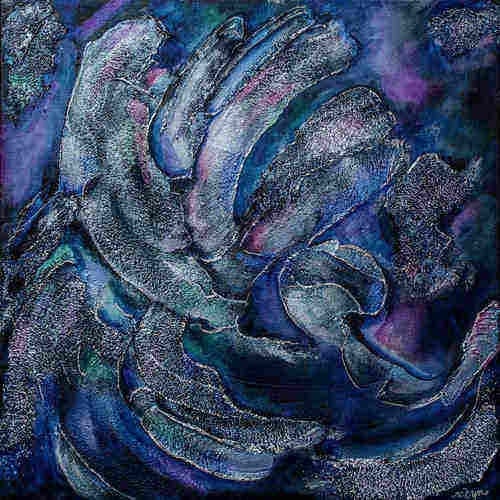
Inspired by her trip to the planetarium, Rennie, who is an artist, created a painting called “Myth,” using textures and rich colours to tell the story of how she sees the universe.

“Stories are the same. Stories are always open to interpretation,” she says.

Myth by Robyn Rennie
Myth, a painting by Robyn Rennie

Featured photo (top): Astrophysicist Matt Russo makes music using the movements of objects in space (photo by Romi Levine)

March 1964: The official opening of the Edward Johnson Building

Ernest MacMillan served as the Dean of the Faculty of Music from 1926 to 1952. During this time, enrollment fluctuated between about 50 and 60 students, though that number declined during World War II. During much of this period there were only three faculty members: Sir Ernest MacMillan as Dean (he was knighted in 1935 for his services to music in Canada), with professors Leo Smith (a cellist, composer, and historian) and the long-serving Healey Willan (an organist and composer). Meanwhile, the University of Toronto had also assumed responsibility for the Toronto Conservatory of Music in 1919. The TCM was renamed the Royal Conservatory of Music in 1947, and remained under the aegis of the University of Toronto until 1991.

Regular classes (as opposed to a limited set of lectures) were gradually introduced in the 1930s. With the appointments of Arnold Walter in 1945, Robert Rosevear in 1946, and Richard Johnston in 1947, the curriculum was Americanized in rapid measure. The year 1946 saw the creation of the Opera School, and the introduction of a degree in School Music (renamed Music Education in 1953) which proved to be vital for the postwar expansion of music education across Canada. Postwar growth saw a significant increase in holdings of the Music Library under Jean Lavender (from 1947) and Kathleen McMorrow (from 1967), the launch of graduate programs in composition, musicology, and music education in 1954, and the opening of the University of Toronto Electronic Music Studio (UTEMS), the second such facility in North America, in 1959. A corresponding growth in student numbers created an urgent need for a new building. Up to this point, the Faculty of Music had been located in two old houses beside the Royal Conservatory of Music at the southwest corner of University Avenue and College Street. The sale of that property to the Ontario Government for the new headquarters of Ontario Hydro raised $3 million, and the Canada Council provided a grant of close to $1 million. These funds enabled the construction of a new building for the Faculty of Music at 80 Queen’s Park, behind Falconer Hall; at the same time McMaster Hall on Bloor Street was renovated for the Royal Conservatory of Music.

The new Edward Johnson Building at the time of the official opening in 1964; photo by Gilbert A. Milne (1914-1991), Toronto, source: http://heritage.utoronto.ca/chronology. Note the lack of an access ramp, which was not added until the 1980s.

The famed Canadian tenor Edward Johnson, a member of the university’s board of governors, had helped to set the wheels in motion for a new music building before his death in 1959. The Music Library was supposed to be named in his honour, but in the event the entire building was named after him, perhaps due to the influence of his daughter Fiorenza, who was married to George Drew, a former premier of the province of Ontario. The 815-seat opera hall in the new building was named MacMillan Theatre to recognize Sir Ernest’s many years of dedicated service to the university. In 1974 the building’s 490-seat concert hall was named Walter Hall in honour of Arnold Walter (1902-1973), who was the director of the Faculty of Music from 1952 to 1968.

The Edward Johnson Building has a number of structural and architectural problems: poor sightlines in the balcony of MacMillan Theatre make those 172 seats all but unusable; the third floor is on a smaller footprint than the rest of the building; there is no cafeteria; and Taddle Creek, an underground stream which runs beneath Philosopher’s Walk on the west side of the building, creates damp conditions (mushrooms have been known to grow in some basement offices). Notwithstanding these problems, the new Edward Johnson Building was the finest university facility for music education in Canada. It opened for classes in the fall of 1962, but the final stages of construction continued on until early in 1964; as a result, the official opening of the building was delayed until March 1964.

Members of the cast of the 1964 production of Britten’s Albert Herring, performed March 4 and 6 as part of the opening ceremonies of the Edward Johnson Building.

The opening ceremonies of the Edward Johnson Building began on 2 March 1964 and continued with a week-long festival of music. The Overture and first two parts of MacMillan’s England: An Ode, which as noted above was completed in the same year that the Faculty was created, was performed on day one, conducted by the composer. Other concerts that week ranged from early music performances under the direction of Greta Kraus, to Benjamin Britten’s opera Albert Herring. Included were works by Faculty of Music composers (John Beckwith, Richard Johnston, Oskar Morawetz, Godfrey Ridout, Arnold Walter, Healey Willan, and Gerhard Wuensch), some of them in premiere performances.

The fine new music facilities continued to attract record numbers of students. The student body grew to 500 by 1972, and alumni soon spread to every part of Canada and many countries abroad. The influence that they have exercised on the musical life of Canada and the world has been enormous.

Author:
Professor Robin Elliott
Jean A. Chalmers Chair in Canadian Music
Director, Institute for Music in Canada

June 1918: The Faculty of Music holds its first meeting at the end of World War I

Before 1918, the University of Toronto awarded degrees in music to external candidates who completed a set of exams. The first was given out in 1846, and 72 degrees had been awarded by 1918. Candidates prepared for these exams by studying questions from earlier exam papers, which were made available in published form. As early as 1904, these published music exam papers bore the designation “University of Toronto Faculty of Music”. So what happened in 1918 that was in any way different from what had gone on beforehand?

The short answer is that on 7 March 1918 the Senate of the University passed a motion to establish a Faculty of Music “which would inaugurate teaching of a university grade and be responsible for the conduct of all examinations in music”. Instead of just setting and grading exams, the University of Toronto would now be in the business of actually teaching music. The inaugural meeting of the Faculty of Music duly took place on 25 June 1918, which marks the beginning of administrative operations for this new academic unit in the university. The minutes of that first meeting have been preserved in the University Archives, and begin as follows:

Scan of original Faculty Council meeting minutes, 25 June 1918.

Faculty of Music. The first meeting of the Faculty of Music of the university was held in the Croft Chapter House, June 25th, 1918 at 11 am. Present: Sir Robert Falconer, President; Dean Vogt; Mr. Fricker; Dr. Ham; Mr. Mouré; Mr. Willan.

Falconer, who served from 1907 to 1932 as the fourth president of the university, had been knighted in 1917 for his services on behalf of wartime recruitment. His name is preserved in Falconer Hall, the Faculty of Law building which sits in front of the Faculty of Music’s Edward Johnson Building. He was a strong proponent for the role of the arts in university education, and his role in the founding of the Faculty of Music reflects that stance.

Dean Augustus Vogt

Dean Augustus Vogt

Dean Vogt (Augustus Stephen Vogt, 1861-1926; pictured here), despite his German heritage and advanced musical training at the Leipzig Conservatory, was Canadian-born, which was fortunate, as the university forced out all of its German-born faculty members during the First World War. A noted organist and choir director (he founded the Toronto Mendelssohn Choir in 1894), in 1913 he had been appointed as the principal of the Toronto Conservatory of Music, and in 1918 he added on his duties as the first Dean of the University of Toronto Faculty of Music, serving in both capacities until his death in 1926. The others present at that first meeting in 1918 – Herbert Fricker, Albert Ham, Ferdinand Mouré and Healey Willan – were English-born organist-composers. To upgrade their credentials, three of them were given honorary doctorates by the university, Willan in 1920, Mouré in 1922, and Fricker in 1923 (Ham and Vogt already had doctoral degrees).

Public lectures on music were given for the first time by University of Toronto music professors early in 1919; they were held in University College, Room 37, on Mondays and Fridays at 4:30 pm. A total of 18 lectures in all were given that first year. The lectures covered topics in music theory and music history – the information one needed to master in order to pass the university’s music exams. The education on offer was conservative, but it was not entirely old fashioned: a music history exam of 1919 included a question about Debussy, who had died the year before, and a question from the 1925 second year music history exam was “Name some of the leading American composers and their works.”

Elsewhere in June 1918…

Portrait of Sir Ernest MacMillan by Kenneth Forbes.

When the Faculty of Music was founded, Ernest MacMillan, who in 1926 would succeed Vogt as the second Dean of the Faculty, was in a prison camp in Germany. He attended the Bayreuth Festival in the summer of 1914, and was still in Germany when war was declared. He was rounded up as an enemy alien, and spent the entire war in Ruhleben, a civilian detention camp in a converted racetrack on the outskirts of Berlin. Fortunately the camp had a vigorous musical life. MacMillan participated actively in the varied musical events there, and was even able to complete an Oxford D.Mus. degree in absentia by writing his thesis composition, England: An Ode, during his abundant spare time. He received word of his success from Oxford on 13 June 1918, just twelve days before the first meeting of the Faculty of Music. He is pictured here in his Oxford doctoral robes in a portrait by Kenneth Forbes, which hangs outside MacMillan Theatre in the Edward Johnson Building.

Written by:
Professor Robin Elliott
Jean A. Chalmers Chair in Canadian Music
Director, Institute for Music in Canada

Wine and cheese for all!

A couple of weeks after I started working at the Faculty I coordinated a wine and cheese reception in room 130 for donors and patrons of the Jazz Studies program after a big band concert in early April. I hadn’t been given much direction and Prof Terry Promane asked me if students could come. Sure, why not I said. Well, the concert came and afterwards people starting coming into room 130. And they kept coming. And they kept coming. And they kept coming. Then the students all arrived. I’m pretty sure we had well over 200 people in that little room and it was one hopping party that went quite late. It was a fun, slightly wild introduction to the Faculty of Music.

  • Tyler Greenleaf, Faculty of Music staff member

Percussion prank war!

About eleven years ago there was a long prank war that happened in the percussion studio at U of T. Early one morning, after many, many previous pranks, I went into the practice room and wrapped my friend Greg’s entire drum set in toilet paper. Kick pedal and all. He walked in as I was wrapping the final piece and as he stared in shock, I blurted: “Wait, I’m not done yet….!” I’ll never forget how hard we laughed that day.

  • Michelle Hwu (BMusPerf 2010)

16 reasons to watch the Junos this year (2016)

43 Faculty of Music alumni, students and faculty from U of T nominated in 8 categories

Forty-three University of Toronto musicians, from jazz to classical to world music, have received 16 Juno nominations.

Three U of T composers – one student and two alumni – have Classical Composition of the Year-nominated pieces. Dinuk Wijeratne, a Doctor of Musical Arts candidate, John Burge (MMus 1984, BMus 1983) and Jordan Pal (DMA 2011) join only two other candidates in this category.

The Classical Album of the Year categories – Solo or Chamber Ensemble and Vocal or Choral Performance – are also strong with U of T alumni, such as the Cecilia String Quartet (currently the Faculty of Music’s Ensemble-in-Residence and performing a student-composed piece tomorrow at noon). The Aradia Ensemble worked with soprano Claire de Sévigné (MMus 2011) on Vivaldi: Sacred Music, Vol. 4.

“I am so excited to be nominated,” says de Sévigné. “I initially signed on to this album as a passion project since I wasn’t sure I could do Vivaldi’s music justice at the time. But I was encouraged to make the music my own. I am so proud to say that I was included in this project with a wonderful group of Canadian musicians.”

Five nominations are in jazz categories – Vocal Jazz Album of the Year, Jazz Album of the Year: Solo and Jazz Album of the Year: Group – including recent alumna Tara Kannangara (pictured below in a photo by Vanessa Paxton) nominated for her vocal album Some Version of the Truth.

“The nomination was a complete surprise, definitely unexpected as we are just emerging on to the Canadian Jazz scene,” says Kannangara, who graduated in 2013. “That being said, I’m very proud of the work that my group put into the album; it was a true labour of love. I’m thrilled that our hard work is being recognized, and I’m happy that the Junos took a chance on us.”

photo of Tara

The Afiara Quartet’s album Spin Cycle, nominated for Instrumental Album of the Year, features compositions by three alumni and Wijeratne, including the piece nominated for Composition of the Year, while the Lemon Bucket Orkestra (with two alumni) were nominated for World Music Album of the Year with Moorka.

As well, another of the pieces nominated for Best Classical Composition, Centennials by Michael Oesterle, was commissioned and recorded by the Gryphon Trio, which includes Professor James Parker, Rupert E. Edwards Chair in Piano and Associate Professor Annalee Patipatanakoon

“It’s inspiring to see the continued presence of U of T Music’s faculty, students and alumni in the Juno nominations,” says Dean Don McLean. “The Faculty continues to be an engine for the creative arts culture in Canada. It’s a testimony to the excellence of teaching and training for professional musicians that the Faculty is known for.”

Listen to Wijeratne’s composition:


The 2016 Juno Awards will broadcast on Sunday, April 3 in Calgary. Here is the full list of nominees:

Vocal Jazz Album of the Year

1. Clear Day – Emilie Claire Barlow – Members Jon Maharaj, bass (BMusPerf 2003), Chris Donnelly, piano (MMus 2007, BMusPerf 2005), Kelly Jefferson, tenor saxophone (faculty), Jason Logue, trumpet (faculty), Kevin Turcotte, trumpet (faculty), Terry Promane, trombone (faculty) and Kelsey Grant, trombone (faculty)

2. Some Version of the TruthTara Kannangara, trumpet and vocals (BMusPerf 2013) with members Colin Story, guitar (BMusPerf 2010), Chris Pruden, piano (BMusPerf 2010) and Mackenzie Longpre, drums (BMusPerf 2010)

Jazz Album of the Year: Solo

3. DuetsTara Davidson, alto and soprano saxes (BMusPerf 2002), with members Trevor Hogg, tenor saxophone (BMusPerf 1998), David Occhipinti, guitar (instructor), David Braid (BMusPerf 1998, faculty), Mike Murley (faculty) and Andrew Downing, acoustic bass and cello (MMus 2008, BMusPerf 1996)

4. What I Hear Now – Jerry Granelli trio featuring Lecturer Mike Murley, tenor saxophone, and DMA candidate Dani Oore, tenor and soprano.

Jazz Album of the Year: Group

5. Forest Grove – Allison Au Quartet – John Maharaj, bassist (BMusPErf 2003)

6. Sheer Tyranny of Will – Peripheral Vision – Don Scott, guitar (BMusPerf 2001), Michael Herring (BMusPerf 2000), Trevor Hogg, tenor saxophone (BMusPerf 1998)

Instrumental Album Of The Year

7. Spin Cycle – The Afiara Quartet – Features compositions by Kevin Lau (DMus 2012, MMus 2007, BMus 2005), Laura Sgroi (DMA 2014, MMus 2010, BMus 2008), Rob Teehan (BMusPerf 2005) and Dinuk Wijeratne (current DMA student)

Classical Album of the Year: Solo or Chamber Ensemble

8. Mendelssohn: Op. 44 nos. 1,2 – Cecilia String Quartet – Members Min-Jeong Koh (DMA 2014, BMusPerf 2007), Sarah Nematallah (MA Music 2013, BMusPerf 2006), Caitlin Boyle (DMA 2015)

9. Chamber World by Jerzy Fitelberg – ARC Ensemble – Members Marie Berard (ArtDip 1983 and faculty), Steven Dann (BMusPerf 1977), Erika Raum (BMusPerf 1993 and faculty), Joaquin Valdepenas (faculty), Dianne Werner (BMusPerf 1979)

Classical Album Of The Year: Vocal Or Choral Performance

10. Vivaldi: Sacred Music, Vol. 4Claire de Sévigné (MMus 2011), Maria Soulis (BMus 1986), and Aradia Ensemble members Nadina Mackie Jackson (faculty), Ed Reifel (DMA 2011), Paul Zevenhuizens (BMusPerf 1984), Paul Jenkins (MMus 1988, BMusPerf 1986) and Elyssa Lefurgey-Smith (BMus 2004)

11. Sacred Reflections of Canada – A Canadian Mass – Canadian Chamber Choir – Jeff Reilly, producer (BMusPerf 1983)

12. Peter-Anthony Togni: ResponsioJeff Reilly (BMusPerf 1983) with Andrea Ludwig (OpDip 2001)

Classical Composition Of The Year 

13. Two Pop Songs on Antique Poems Dinuk Wijeratne (current DMA student)

14. Piano Quartet John Burge (MMus 1984, BMus 1983)

15. The Afar Jordan Pal (DMA 2011)

World Music Album Of The Year

16. Moorka – Lemon Bucket Orkestra – Members Mike Romaniak, sopilka (BMus 2011), John David William, clarinet (BMusPerf 2008)

Featured image (top): Faculty of Music student Dinuk Wijeratne is one of three U of T composers nominated for Classical Composition of the Year (photo by Michelle Doucette)

Jessica Lewis is a writer with the Faculty of Music at the University of Toronto