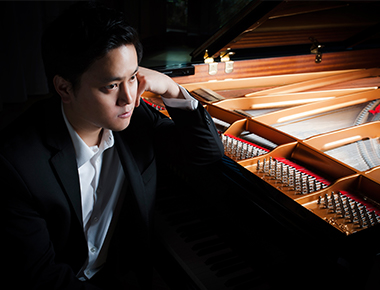
In fall 2004, piano prof Midori Koga started teaching at the Faculty of Music. Since then she has developed and directs the first Canadian MMus and DMA programs in the area of Piano Pedagogy and Performance and she also currently serves as Associate Dean, Graduate Education at the Faculty.
A new knowledge creator, Prof Koga notably published a study on using a Nintendo Wii to improve balance while playing piano.
“Associate Dean of the Faculty of Music, Midori Koga was demonstrating her team’s study of the use of the Nintendo Wii Balance Board to promote the development of awareness of core balance for the purpose of enhancing piano performance. Adults and children were lined up to take a turn standing on the board which showed them an image on a screen of how stable their core was. The premise of the research is that pianists can benefit from developing a strong core by understanding some of the principles of core balance that are central to pursuits such as Aikido.”
Prof Koga is also an avid performer, collaborator, and advocate for contemporary music. She is performing tomorrow night at Koerner Hall with Soundstreams at their Six Pianos performance.
Faculty members and alumni frequently perform with Soundstreams (led by Artistic Director Lawrence Cherney (MMus 1978) and Executive Director Ben Dietschi (MMus 2009)) and this concert is no exception as all performers have U of T Music connections: along with Prof Koga is pianist Stephania Chua (MMus 2006), DMA student pianist Radka Hanáková, percussionist and Professor Emeritus Russell Hartenberger, pianist and instructor Gregory Oh (MMus 1997, BMusPerf 1996), Piano Professor Jamie Parker, and percussionist Ryan Scott (DMA 2015, MMus 1997, BMusPerf 1996).
Professor Walter Buczynski was born in 1933. He studied theory with Godfrey Ridout and piano with Earle Moss and Rosina Lhevinne in New York. He made his orchestral debut in 1955 with the Toronto Symphony playing the Chopin F minor concerto. In 1955 he also won the Fromm Award in Aspen, Colorado under Darius Milhaud. In 1960 he was the first Canadian to compete in the prestigious Chopin Piano Competition in Warsaw, Poland.
He continued his composition studies in Paris with Nadia Boulanger. He returned to Canada in 1962 and taught at the Royal Conservatory of Music until 1969. From 1970 he taught at the Faculty of Music at the University of Toronto where he was a Professor in Theory and Composition.
His compositions have been performed in Canada and abroad – United States, Europe and Asia. In 1977 he received the Queen Elizabeth medal for achievement and development of Canadian Culture. In 1992 he received the Governor General 125th Commemorative medal. In 2008 the Polish Government bestowed on him the Gloria Artis medal for his musical achievement and body of work. After 30 years of teaching at the Faculty of Music he retired from the University. He continues to compose and has resumed his concert career.
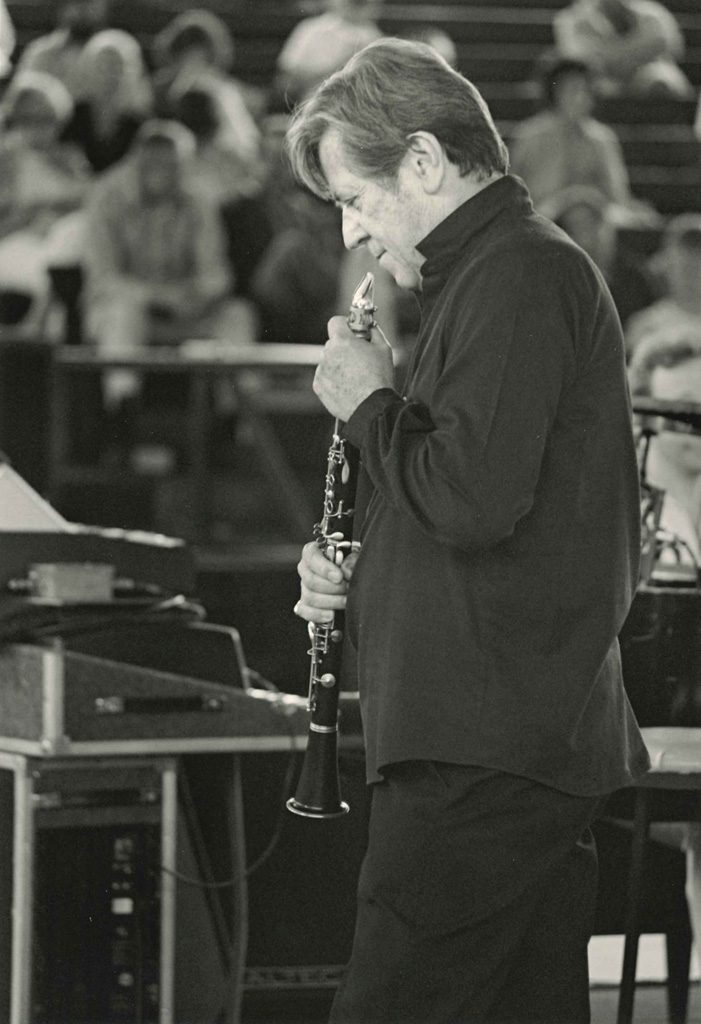
Already an incredibly accomplished performing and touring musician at this point, jazz clarinettist, composer, and band leader Phil Nimmons started teaching a course in jazz techniques at the the Faculty in 1973.
Phil was known for his band Nimmons ‘N’ Nine that start in 1957. In 1965 it expanded to Nimmons ‘N’ Nine Plus Six. Check out his press kit from 1975 [pdf]. Phil was appointed an Officer of the Order of Canada in 1993.
Phil Nimmons N’ Nine Plus Six perform Bird Burger, 1970:
Last June Phil turned 95 years old and he still comes to the Faculty of Music each week to teach an improvisation class.
On Monday, October 1 we are excited to have Phil Nimmons in Walter Hall with pianist David Braid (BMusPerf 1998) for “Nimmons ‘N’ 95”, hosted by Heather Bambrick (BMusPerf 1997).
Phil Nimmons performing in Toronto, photo by Bruce Litteljohn.
David Braid is a graduate of the Faculty of Music and jazz piano instructor.
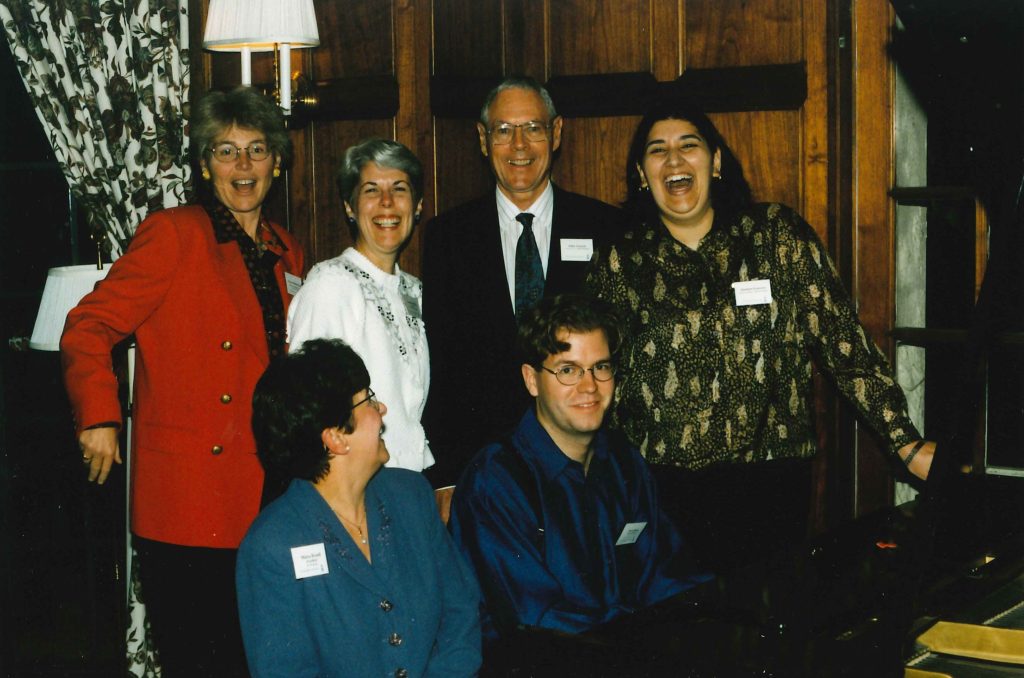
Below is a photo of David from 1999 when he performed at an U of T Alumni Association event at the President’s House. Behind him is Dr. John Lawson, a long time supporter of the Faculty of Music and Chair of the Faculty of Music Dean’s Advisory Board in the 90s and early 00s, and on the far right is Marilyn Genovese Brown, who worked in the Faculty of Music’s Development and Alumni Relations Office. Other members in the photo were part of the U of T Alumni Association.
David Braid John Lawson Marilyn Brown 1999 UTAA event
We are two weeks into the academic year and classes are in full swing.
This is a photo of Professor Maria Rika Maniates teaching a history and literature class in 1988.
Born in 1937, Prof Maniates began studying piano at the RCM at the age of 3 and went on to receive her PhD in musicology, specializing in renaissance music from Columbia University in 1965. She joined the Faculty of Music that same year and later went on to contribute to the Centre for Reformation and Renaissance Studies at Victoria College, University Toronto, holding positions with numerous musicological organizations, as well as becoming Vice-Dean of Graduate Studies at U of T in the early 90s before her retirement in 1995. She passed away in October 2011 in Toronto.
“Music in the university is a very old tradition, but it is constantly changing. We are now trying to represent serious musical action. Our task is to keep up with or even ahead of what’s happening – representing as effectively as possible what is taking place in music.” – Dean John Beckwith, 1970
In 1970, the Faculty kicked off its academic year with new hires Charles Daellenbach and John Hawkins.
This year, we welcome Prof Remi Chiu (photo above), a Renaissance specialist, who comes to us from Loyola University Maryland as well as violinist Prof Mark Fewer. Prof Sarah Gutsche-Miller and Prof Ellen Lockhart moved to full-time tenure-track positions, and Prof Kenneth McLeod moved from UT-Scarborough campus to St. George campus. We are very pleased to welcome Remi to U of T Music and these other colleagues to their new roles.
As many people have observed, the University of Toronto’s music building is named after the opera man and its opera theatre is named after the music man (referring in turn to the Edward Johnson Building and to its opera hall, MacMillan Theatre). Ernest MacMillan had conducted opera in the 1920s for the Toronto Conservatory Opera Company, but as the longtime conductor of the Toronto Symphony and the Toronto Mendelssohn Choir, he was more closely involved with concert music than opera. He enjoyed a long association with the University of Toronto, first as a student, and later as a professor and the Dean of the Faculty of Music. The naming of the opera theatre in his honour was a well-deserved recognition of his important contributions to music at the University of Toronto. But who was Edward Johnson, the “opera man,” and what was his connection to the University of Toronto?
Edward Patrick Johnson – Eddie to his friends and family – was born in Guelph, Ontario in 1878. On the strength of his early successes as a church and oratorio soloist, he moved to New York City in 1899 to study singing seriously. He soon found lots of work as a tenor and had many prestigious church, concert, oratorio, and operetta appearances, but recognition in opera eluded him. So he travelled to Paris for further vocal training, working with Beatriz d’Arneiro, a Portuguese pianist and vocal coach. Their close working association soon led to a romantic relationship, and they married in 1909. Still more training followed in Florence, Italy, where the couple’s first and only child, a daughter, was born in 1910; she was christened Fiorenza in honour of the city of her birth.
On January 10, 1912, Johnson made his operatic debut in the title role of Giordano’s verismo opera Andrea Chénier in Padua. (Of the 40 or so recordings he made later, four are of tenor arias from this opera.) For the next seven years, he enjoyed great success in the verismo operatic repertoire in Italy and abroad, performing under the stage name Edoardo Di Giovanni (the Italian translation of his name). Signal moments included his debut at La Scala opera house in Milan in the title role of the first Italian staged performance of Wagner’s Parsifal in 1914, and singing the lead tenor roles in the Italian premiere of Puccini’s Il trittico in Rome in the presence of the composer in 1919. The Italian sojourn came to an unhappy end when his wife Beatriz died in 1919; heartbroken, Johnson elected to start a new career back in the United States.
Edward Johnson- Romeo at Metropolitan Opera 1923
For three seasons, Johnson sang with the Chicago Opera and then, in 1922, he made his debut at the Metropolitan Opera in New York. For thirteen seasons, he sang leading roles at the Met, including Pelléas in the first Met production of Debussy’s Pelléas et Mélisande in 1925 (with the Canadian conductor Wilfrid Pelletier in the pit). In addition to many performances of 60 different operatic roles, he also had a busy recital career that took him across North America and as far abroad as Japan, Korea, and China. Robertson Davies has left a fine account of a recital that Johnson gave in 1927, at the height of his career, in Kingston, Ontario. “There was something princely about him,” Davies remarked. “And for all of us Edward Johnson was a splendid figure, because, to crown his other great qualities, he was one of us, and princes were in short supply in Canada in those days. Indeed, they have never been so numerous that we have grown tired of them.” [One Half of Robertson Davies, Penguin Books 1978, p. 26-27]
A new chapter in Johnson’s life began in May 1935, when he unexpectedly became the General Manager of the Metropolitan Opera upon the sudden death of Herbert Witherspoon, who had been in the job for less than two months. Johnson would serve for 15 years, setting up the Metropolitan Opera Guild and steering the company successfully through the Second World War. He also increased the number of North American singers in the company, and introduced the Metropolitan Auditions of the Air.
Meanwhile, Johnson’s ties to Canada remained strong. In 1936, his daughter Fiorenza married the Ontario lawyer and politician George Drew, who was the premier of Ontario from 1943 to 1948 and then, switching to federal politics, was leader of the Progressive Conservative Party of Canada from 1948 to 1956. Being the father-in-law of such a prominent politician only strengthened Johnson’s voice in Canadian affairs. In 1945 Johnson was appointed to the Board of Governors of the University of Toronto, and that same year he was named the chairman of the Board of Governors of the Toronto (from 1947 on the Royal) Conservatory of Music.
The postwar era saw some complicated manoeuvring regarding the role of music at the University of Toronto. There was huge growth in student numbers, but also difficult negotiations between the university administration and the university’s two music institutions, the Faculty of Music and the Conservatory. Several strong personalities were involved, each with his (they were all men) distinct vision of how music education at the University of Toronto should unfold. Initially Johnson had little direct input into these matters, as he was still busy running the Met until 1950. Soon after his retirement from the Met, music matters at the university came to head.
In January 1952, Sidney Smith, the president of the university, introduced a new plan for music at U of T, drafted by a committee led by Claude Bissell (who would succeed Smith as the president of the university in 1958). Under the umbrella designation “Royal Conservatory of Music,” there would be a Faculty of Music (offering degree courses) with Arnold Walter as the Director, and a School of Music (giving pre-university instruction for the most part) with Ettore Mazzoleni as the Principal. There was to be a rector or dean with overall authority for both parts of the Royal Conservatory, but no one had yet been appointed to the position.
The confusion began with the naming of the constituent elements. The School of Music was actually the Conservatory, and people continued to refer to it as such. The Faculty of Music was technically “the Faculty of Music of the Royal Conservatory of Music of the University of Toronto,” but scarcely anyone used this unwieldy name for it; it was just the U of T Faculty of Music. MacMillan was offered the position of rector/dean, but felt that he was too busy with his conducting duties to take up this post, so he retired from the university, feeling unhappy with the way that the entire reorganization plan was unfolding. Mazzoleni, who was his brother-in-law, also tendered his resignation. Turf wars ensued, tempers flared, backroom intrigue flourished, and the whole imbroglio made front-page head headlines in the local papers. “MacMillan Retires, Mazzoleni Resigns as Discord Rocks Royal Conservatory: Dispute Appointments in New U of T Setup,” read the page one headline in the Globe and Mail on April 28, 1952.
Edward Johnson Drew family picture December 1958 in Guelph. Left to right: Sandra Drew, Edward Johnson, George Drew, Edward Drew, and Fiorenza Drew.
As a member of the governing boards of both the U of T and the Conservatory, Johnson was tasked with smoothing things over. He agreed to act as the interim rector/dean of the Royal Conservatory until the post could be filled. Upon learning of this, Mazzoleni rescinded his resignation (to MacMillan’s surprise and disappointment). Arnold Walter’s title was Director of the Faculty of Music, but his portrait hangs in the EJB along with the other Deans of the Faculty. Johnson served without pay as the interim Dean during the 1952-53 academic year; his portrait does not hang with the other Deans, though a fine portrait of him by Eugene Speicher hangs in one of the two main entrances to MacMillan Theatre (a portrait of MacMillan by Kenneth Forbes hangs in the other entrance). Boyd Neel was appointed as the Dean of the Royal Conservatory in 1953, to oversee both divisions, and occupied the position until 1970. Johnson was initially not keen on relinquishing his influence or cooperating with Neel. President Smith finally had to tell Johnson to stop interfering with the running of the Conservatory, at which point Johnson stepped aside, though he did remain on the Board of Governors.
Johnson spent his remaining years divided between Guelph and Toronto, with regular trips to Ottawa to visit his daughter and son-in-law, and to Europe, especially his beloved Italy. He was involved in preliminary plans for a new building for the Faculty of Music – the building that now bears his name. He did not live to see the building, though; he died of a heart attack while attending a performance by the National Ballet of Canada in Guelph on April 20, 1959. Two years later, on the anniversary of his death, his daughter Fiorenza (Mrs. George Drew) laid the cornerstone for the building that bears her father’s name. “This building is in spirit the true receptacle of his heart,” she remarked on that occasion, “and so it will always remain.”
Edward Johnson Building Stone at 80 Queen’s Park
Author: Professor Robin Elliott
Jean A. Chalmers Chair in Canadian Music
Director, Institute for Music in Canada
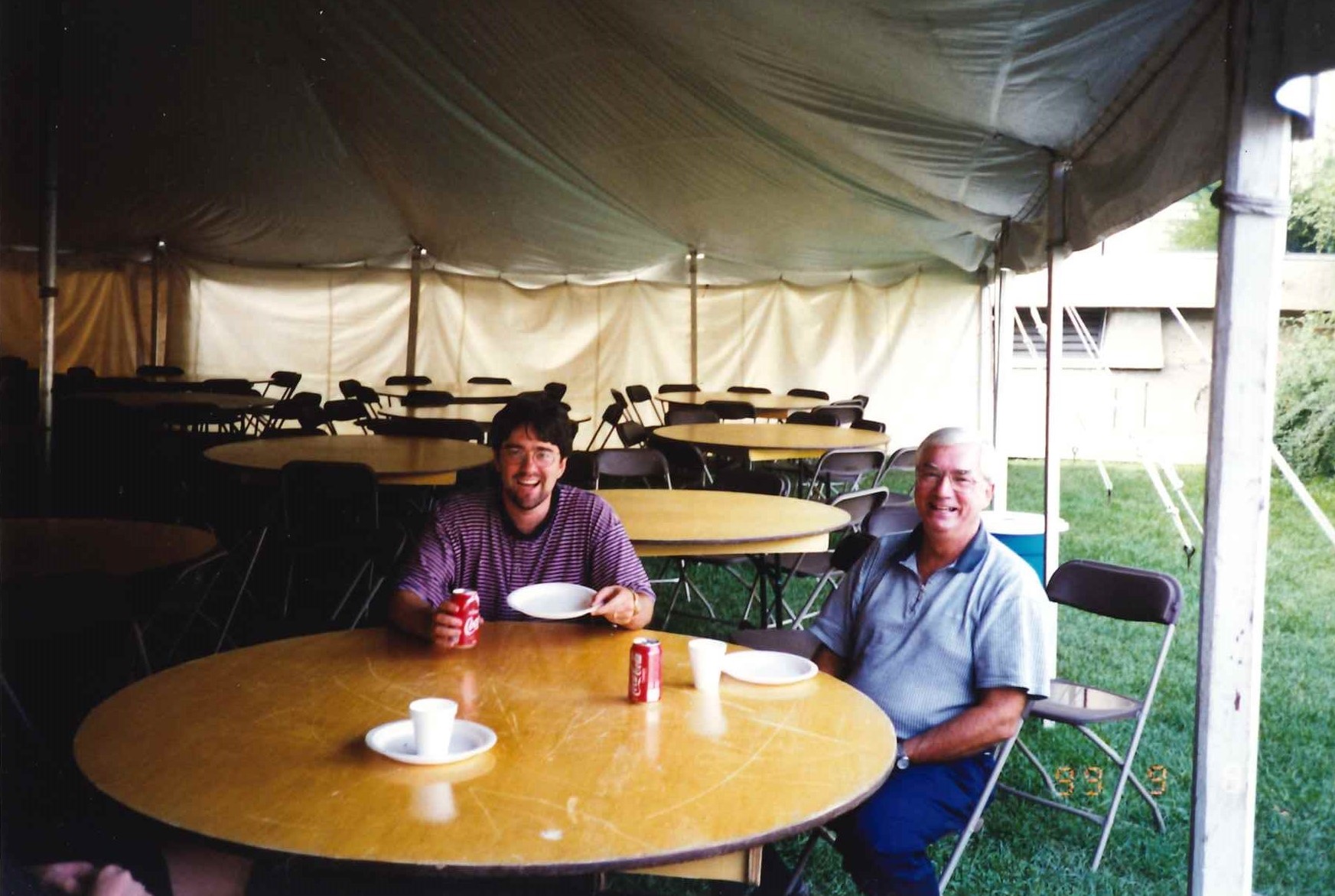
Welcome back to school everyone! Back in 1999 Frosh Week had a barbeque on the quad south of the Edward Johnson Building. Photo above: Music Theory Prof Mark Sallmen enjoying the afternoon with organist Prof William Wright. Prof Sallman had joined the Faculty three weeks prior to this photo. In 2014, he received the Faculty of Music’s Award for Excellence in Teaching.
On August 23, 2018, Professor Emeritus Eli Kassner passed away. Prof Kassner was a giant in classical guitar studies in Canada. His students went on to perform and teach around the world.
After forming the Guitar Society of Toronto in 1956, Eli began teaching guitar at U of T in 1959. In 1975 he organized Guitar ’75, an international guitar festival at the Faculty of Music. Over 500 attendees converged and led to additional festivals in 1978, 1981, 1984, and 1987.
Prof Kassner also was a huge proponent of commissioning new works for classical guitar. As of late 1980s he and the Guitar Society of Toronto commissioned about 70 new works. As told to Harold Levy in the Eli Kassner 65th Birthday Tribute Program (held in Walter Hall on May 27, 1989), composer Harry Somers outlines his first composition for Eli:
GUITAR CANADA: Did it take very long before you were writing some compositions for the guitar, Harry?
HARRY SOMERS: Well, it took a few years, and it really came about as a result of the instigation of the Guitar Society. They asked me to do a composition for them, so I wrote a sonata for fifty bucks.
G.C.: And what was it called?
H.S.: Well, Eli Kassner called it the Sonata for Fifty Bucks.
G.C. At least the Guitar Society got its money’s worth.
H.S. True, but maybe I should have done fewer movements!
Eli and his wife Ann (who passed away in 2017) were a vital part of our music community and they will be deeply missed.
In August 22 years ago, Professor Stephen Chenette completed an 80 day bike trip across the USA. He made stops along the way to perform trumpet duets that he commissioned for this trip.
Stephen Chenette bicycle trip article 4 August 1996
The Edward Johnson Building officially opened on March 2, 1964, despite activity taking place in the building since July 1962. The delay was primarily due to having to rebuild the balcony in MacMillan Theatre to offer sightlines to the stage. The first work performed that evening was “God Save the Queen”, arranged for chorus and orchestra by Sir Ernest MacMillan.
The second piece performed on that opening program evening was the overture for England: An Ode by Swinburne, set to music by Sir Ernest MacMillan.
Guess what the U of T Symphony Orchestra is opening their performance season with on Saturday, September 29? You guessed it, the overture from England: An Ode.